Why I write beyond science
I have spent most of my professional life asking questions through experiments: formulating a hypothesis, looking for evidence, and changing the explanation when the evidence demands it. Over time, I became increasingly interested in questions that are difficult to contain within a laboratory.
How much of human behavior is biological, and how much is cultural? What can ancient practices tell us when they are examined with modern scientific tools? How different might another human species have been from us if it had grown up in our world? Why do civilizations repeatedly preserve some parts of their past while forgetting, transforming or mythologizing others?
These questions led me toward what might broadly be called popular science, although some of the books move well beyond conventional science writing. They draw on genetics, medicine, archaeology, history, psychology and anthropology. In some cases I investigate claims that science treats skeptically—not to validate them, but to ask a more interesting question: what can actually be tested?
The books below are different from one another, but they share an approach I bring from science: curiosity without requiring belief, skepticism without requiring dismissal, and a willingness to follow evidence somewhere unexpected.
Themes in my writing
My current books follow several connected lines of inquiry. Some begin with biology and ask what makes us human. Others examine ancient beliefs and unusual claims through the methods of modern science. A third group turns toward history itself—asking how civilizations, landscapes and collective memory change, and how confidently we can reconstruct worlds that have disappeared.
Biology, identity & the human condition
These books use biology as a starting point for questions about identity, behavior and what it means to be human. They range from the meanings we attach to our bodies to thought experiments about human evolution and speculative worlds that allow familiar biological ideas to be seen from an unfamiliar perspective.
The Marked Body • The Neanderthal Experiment • The Known World
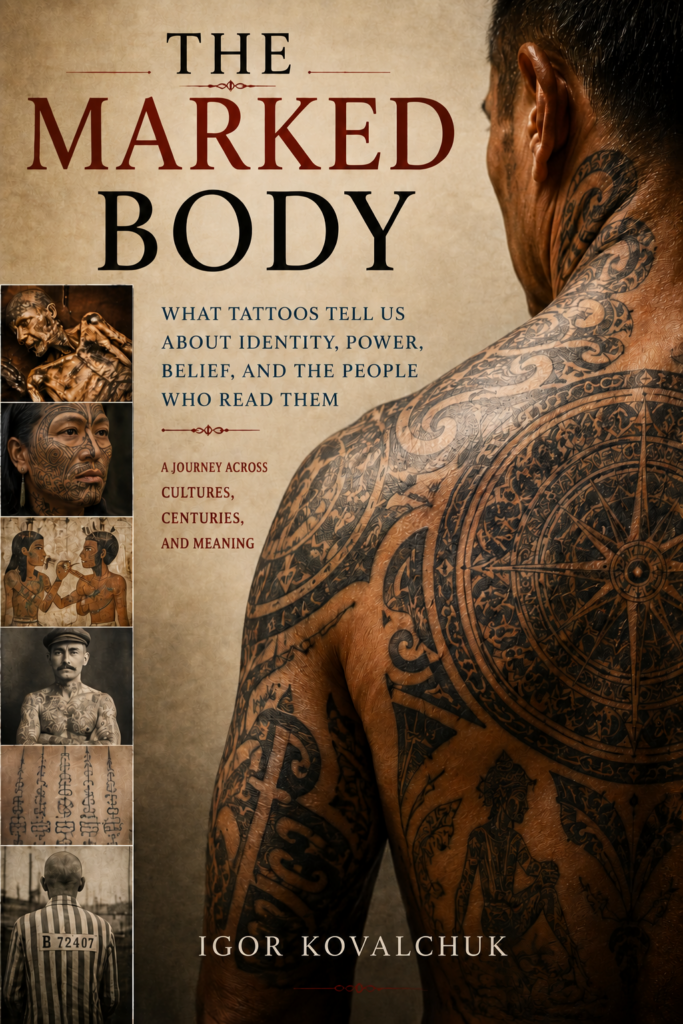
THE MARKED BODY
What Tattoos Tell Us About Identity, Power, Belief, and the People Who Read Them
Narrative nonfiction • Book project
Why have humans marked their bodies for thousands of years—and why do those marks matter so much to the people who see them?
The Marked Body follows tattooing from some of the earliest surviving marked bodies through Polynesian traditions, pilgrimage and sailor tattoos, criminal codes, sacred and protective markings, forced identification, and the modern normalization of tattoo culture. But it is not simply a history of tattoos. The book asks what happens when the human body becomes a surface that other people believe they can read.
A tattoo may express memory, belonging, status, rebellion, protection or identity to its wearer, while communicating something entirely different to an observer. Historical evidence and modern psychological research reveal how these interpretations can influence judgments about trust, competence, attraction, danger and social belonging. The larger subject is therefore not ink, but a fundamental human behavior: our desire to make identity visible—and our tendency to believe we understand people from the signs we see.
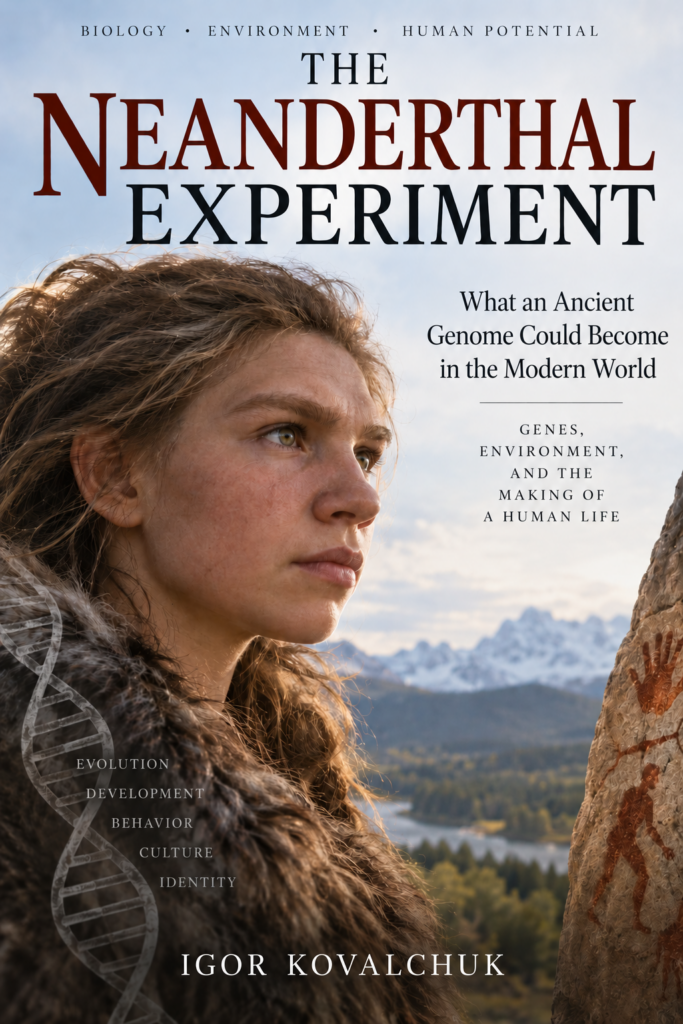
The Neanderthal Experiment
What an Ancient Genome Could Become in the Modern World
Narrative popular science • Book project
What would happen if a Neanderthal genome were given something no Neanderthal ever experienced: a modern human womb, modern nutrition, medicine, education, language and twenty-first-century society?
The Neanderthal Experiment follows Vera, a fictional child created as a scientific thought experiment from a reconstructed Neanderthal-derived genome and raised entirely in the modern world. Rather than asking simply what Neanderthals were like, the book asks a different question: what could an ancient genome become under radically different conditions?
Following Vera from conception through childhood and into adulthood provides a framework for exploring genetics, epigenetics, brain development, anatomy, metabolism, immunity, behavior and learning. At every stage, traits that might appear to be predetermined by ancestry encounter the powerful influence of development, environment and culture.
The experiment ultimately turns the question back on us. If even a genome separated from ours by tens of thousands of years cannot determine a life by itself, how much of our own identity is truly written in DNA—and how much is constructed through the world in which that DNA develops?
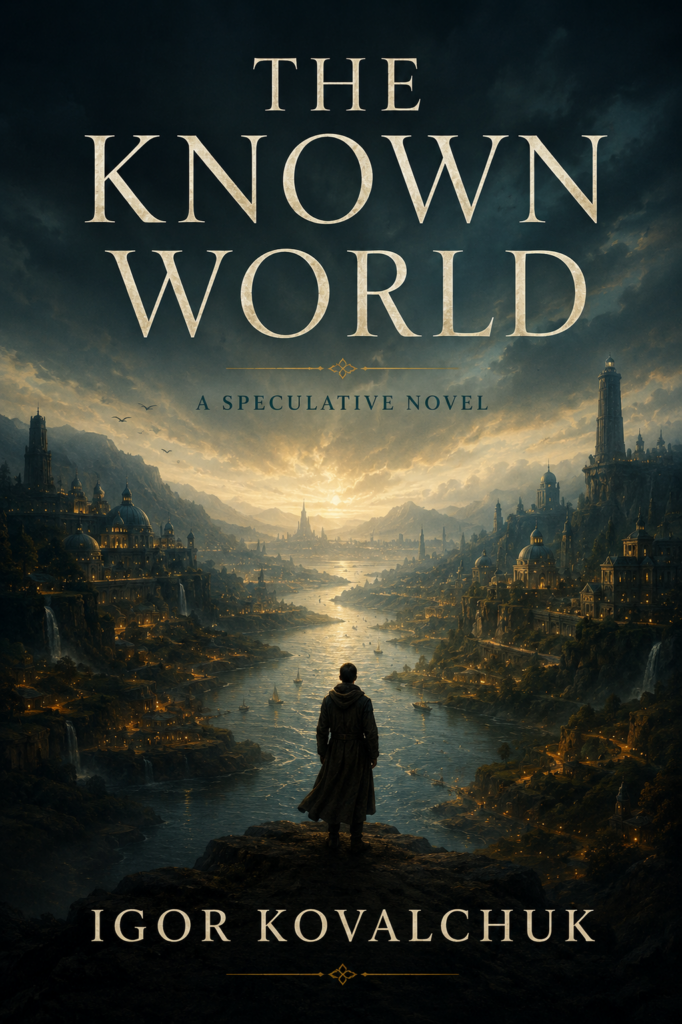
The Known World
How much of reality can we understand from inside it?
Speculative novel • Book project
Mara has spent her life studying the structures and rules of the Known World. Around her, other civilizations have developed their own sciences: some study movement and rhythm, others borders and outsiders, information, inheritance, communication or the mysterious forces arriving from beyond the limits of everything they know.
Their discoveries work. Their measurements are real. Yet the explanations do not fit together.
As researchers from distant parts of the World begin comparing evidence, a disturbing possibility emerges: each civilization may understand its own territory correctly while being profoundly wrong about the nature of the whole. Signals from the Outside, strange travelers, ancient records and observations that should be impossible gradually force them to reconsider what their world actually is—and whether it exists inside something much larger.
The Known World is a scientifically grounded speculative novel about scale, consciousness, cooperation and the limits of knowledge. At its center is a question that applies as much to us as to its characters: if every intelligent observer sees reality from the inside, how would we ever know what lies beyond the boundaries of our own map?
Ancient knowledge, belief & unexplained claims
Across cultures, people have attributed unusual properties to places, objects, rituals and natural forces. Rather than beginning with either belief or dismissal, these books ask what such claims actually are, where they came from, which parts are testable, and what modern science can—and cannot—say about them.
The Forgotten Protocol • Signs of Power • The Land
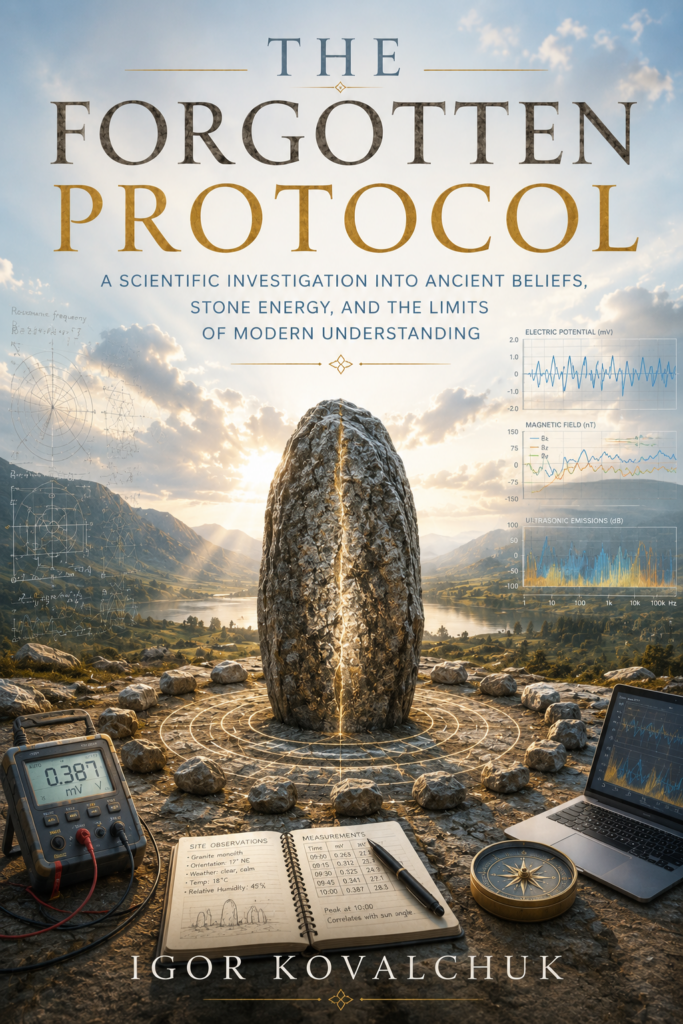
The Forgotten Protocol
What Stones, Sound, Ritual, and the Human Body May Have Been Doing Together
Popular science • Scientific investigation • Book project
What if some practices inherited from the ancient world were neither evidence of mysterious powers nor simply superstition—but fragments of observations whose original context has been lost?
The Forgotten Protocol begins with a simple experiment: vibration causes scattered grains of sand to organize into geometric patterns. From there, scientist Daniel Levin follows the question into mechanobiology, minerals, the human body, sound, architecture and ancient ritual.
The investigation applies a simple rule: do not believe an unusual claim because it is old, but do not dismiss it because its traditional explanation seems impossible. Test what can actually be tested.
What emerges is not evidence for magical crystals, healing frequencies or acoustic levitation. Instead, the book explores whether some ancient practices depended on relationships among materials, bodies, spaces, rhythm and coordinated human action. Objects can survive for millennia; sound, movement, textiles, timing and technique usually do not.
The larger question is simple: could archaeology preserve the pieces while losing the procedure that once connected them?
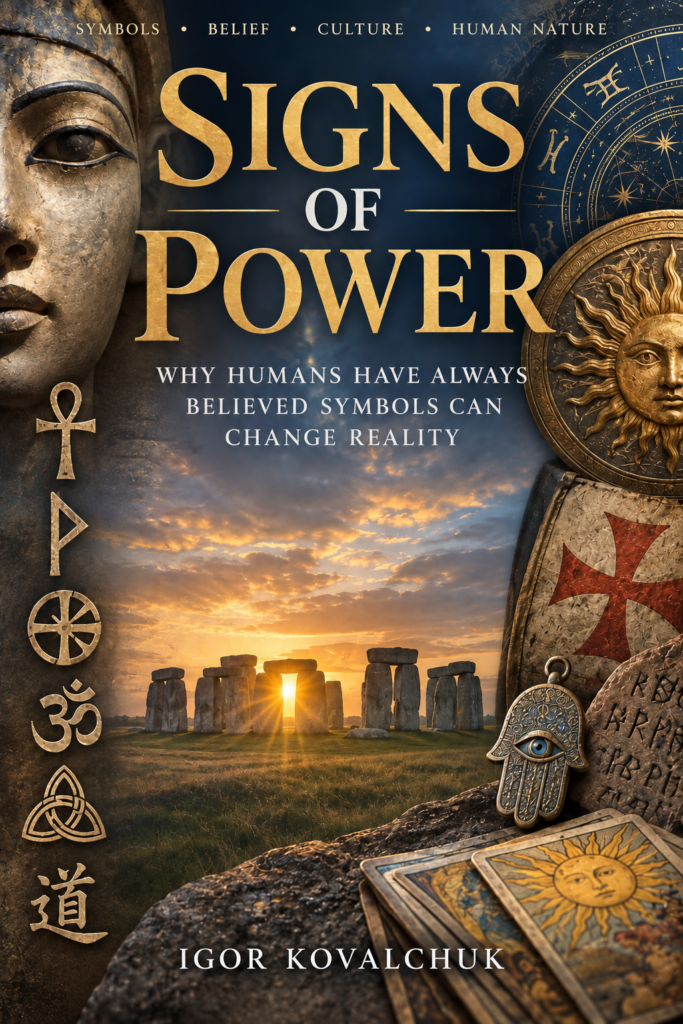
Signs of Power
Why Humans Have Always Believed Symbols Can Change Reality
Narrative nonfiction • Popular history & science • Book project
For tens of thousands of years, humans have carved, painted, worn, feared and fought over symbols. But Signs of Power asks a different question from the usual “What does this symbol mean?” Instead, it asks: what did people expect the symbol to do?
The investigation moves from ancient protective objects and curse tablets to runes, sacred geometry, tarot and symbols whose meanings changed dramatically across history. It separates what archaeology and historical sources actually tell us from interpretations added centuries—or millennia—later.
The book then turns to psychology and experimental science. Some symbols influence perception. Others affect us through expectation, conditioning and learned meaning. Still others acquire extraordinary real-world power because societies agree to act upon them: money, signatures, flags and laws can move people, resources and nations.
Signs of Power therefore avoids both easy belief and easy dismissal. Humans were right about one thing: symbols really can change reality. The more interesting question is how—and whether there is anything left after the known mechanisms have been accounted for.
History, civilization & lost landscapes
These projects examine the more difficult edges of historical reconstruction: changing maps, lost landscapes, catastrophes, contested identities and the distance between the world people once inhabited and the past we reconstruct from surviving evidence. The aim is not to replace established history with another grand narrative, but to distinguish evidence, inference and speculation—and to investigate the questions that remain genuinely open.
Tartaria/history project • Civilization, Catastrophe, and the Lost Landscape •Tartaria – Illustrated Atlas
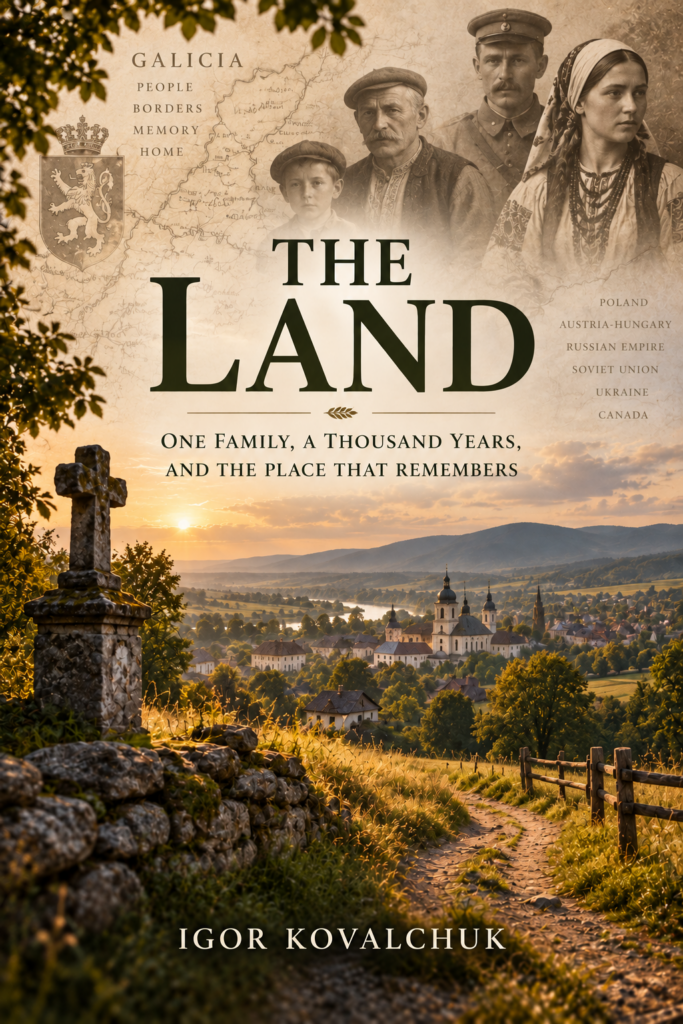
The Land
One Family, a Thousand Years, and the Place That Remembers
Narrative history • Family history • Book project
How much of a family’s past can be recovered when borders move, empires disappear, records are destroyed and generations learn that some memories are safer left unspoken?
The Land follows one small region of Galicia across nearly a thousand years of history. It begins before surviving family records allow individual ancestors to be named, reconstructing plausible lives within the documented world of medieval and early-modern Galicia. Gradually, the archive begins to speak: villages become identifiable, surnames appear, and the story converges on the Machkur, Kovalchuk and Oliynyk families around Stanyslaviv.
Kingdoms, Austria-Hungary, Poland, war, Soviet rule, independence and migration repeatedly change what the same piece of earth is called and who claims to govern it. Eventually the story crosses the Atlantic to Canada, asking what happens to the idea of home when a family leaves the land but continues carrying its language, stories and silences.
At its heart, The Land is less about rulers than about continuity: people plant, marry, raise children, bury their dead, leave, return and remember while political worlds come and go. We possess land only briefly. The land may possess our memory for much longer.
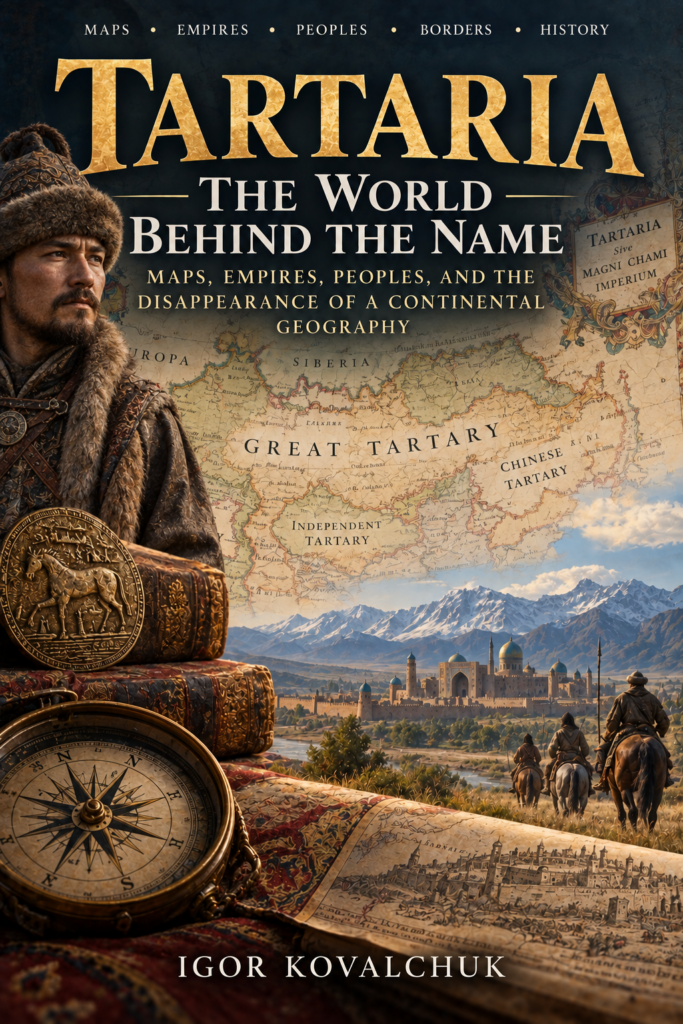
Tartaria: The World Behind the Name
Maps, Empires, Peoples, and the Disappearance of a Continental Geography
Investigative history • Illustrated nonfiction • Book project
For centuries, European maps placed Tartary across an enormous part of Eurasia. Sometimes it appeared as Great Tartary; elsewhere as Muscovite, Chinese, Independent or Little Tartary. Then the name largely disappeared from modern maps. What exactly had those cartographers been describing?
Tartaria: The World Behind the Name takes the old maps seriously without assuming that their largest labels represent a forgotten empire. It tests competing explanations against chronicles, travel accounts, borders, rulers, coins, flags, heraldry, languages, genetics and the expansion of Russia and Qing China.
The investigation deliberately preserves hypotheses that fail as well as those that survive. A map label alone cannot prove political sovereignty; coins, seals, rulers and administrative records provide different tests.
The result is neither a defense of conventional history nor a claim that a lost Tartarian civilization has been erased. The old maps were recording something real. The question is what kind of reality it was.
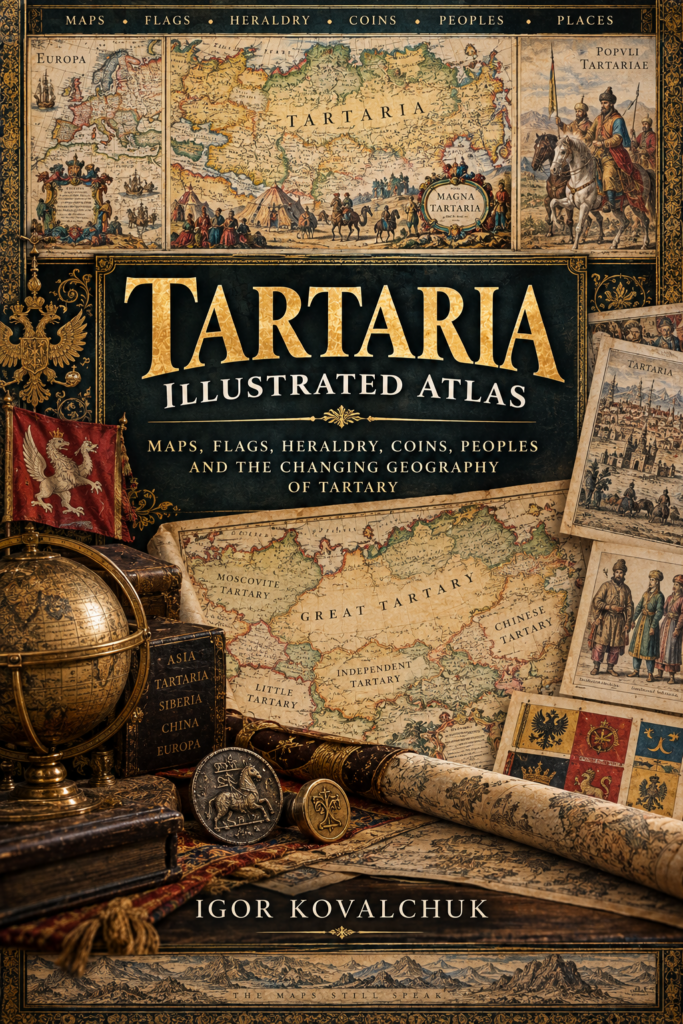
Tartaria — Illustrated Atlas
Maps, Flags, Heraldry, Coins, Peoples and the Changing Geography of Tartary
Illustrated historical atlas • Book project
For centuries, European cartographers repeatedly placed Tartary across enormous areas of Eurasia—but they did not always place it in the same way. Tartaria — Illustrated Atlas turns that changing cartographic record into the subject of the book.
Built around high-resolution historical maps, the atlas follows Tartary from early representations associated with the Great Khan through Great, Muscovite, Chinese, Independent and Little Tartary, and finally into the nineteenth-century maps on which the older geographical vocabulary gradually gives way to Russia, Siberia, Turkestan and other modern names.
Maps are accompanied by period flags, heraldry, coins, seals, tamgas, ruler imagery and other surviving objects that help distinguish geographical labels from actual political authority.
Rather than telling readers what the maps prove, the atlas allows them to see the evidence change across centuries—and to compare what cartographers drew with what contemporary material evidence tells us about the peoples and states beneath the name Tartary.
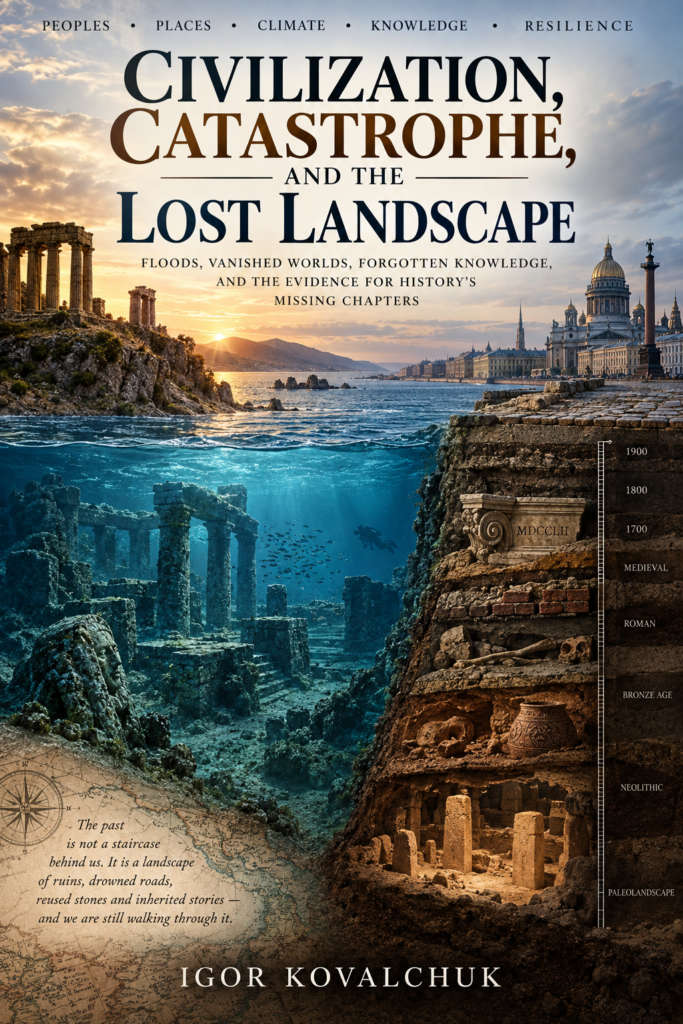
Civilization, Catastrophe, and the Lost Landscape
Floods, Vanished Worlds, Forgotten Knowledge, and the Evidence for History’s Missing Chapters
Investigative history & archaeology • Book project
How much of human history is missing—not because somebody erased it, but because landscapes drowned, climates changed, cities were rebuilt, institutions collapsed and the materials of everyday life simply disappeared?
Civilization, Catastrophe, and the Lost Landscape investigates some of the most provocative claims about the human past: ancient flood memories, submerged landscapes, abrupt climate change, the Green Sahara, Göbekli Tepe, unusual old maps, lost technologies, buried urban levels, “mud floods,” underground cities and the seemingly rapid construction of places such as St. Petersburg.
Rather than dismissing anomalies or assembling them into a single lost-civilization theory, the book asks what each claim predicts—and tests it against archaeology, geology, paleoclimate, engineering and documentary history.
The emerging picture is more interesting than either extreme. Civilization does not repeatedly reset to zero. But landscapes disappear, societies collapse, knowledge is lost and later generations inherit fragments whose original context may be gone. The past is not a staircase behind us. It is a landscape of ruins, drowned roads, reused stones and inherited stories—and we are still walking through it.