Questions that cross boundaries
Some questions do not belong comfortably to a single academic discipline.
What makes us who we are? How much of human behavior is written in biology, and how much emerges from environment, culture and experience? What happens when traditional knowledge encounters modern science? How confidently can we reconstruct the past from incomplete evidence? And when an unusual claim seems implausible, is the best response to believe it, dismiss it—or find a way to test it?
These are questions I increasingly explore outside conventional scientific publications. They take me from genetics and medicine into archaeology, history, psychology, human evolution and culture.
I approach these subjects as a scientist, but not with the assumption that science already has every answer. The more useful starting point is often simpler: What do we actually know? How do we know it? And what evidence would change our minds?
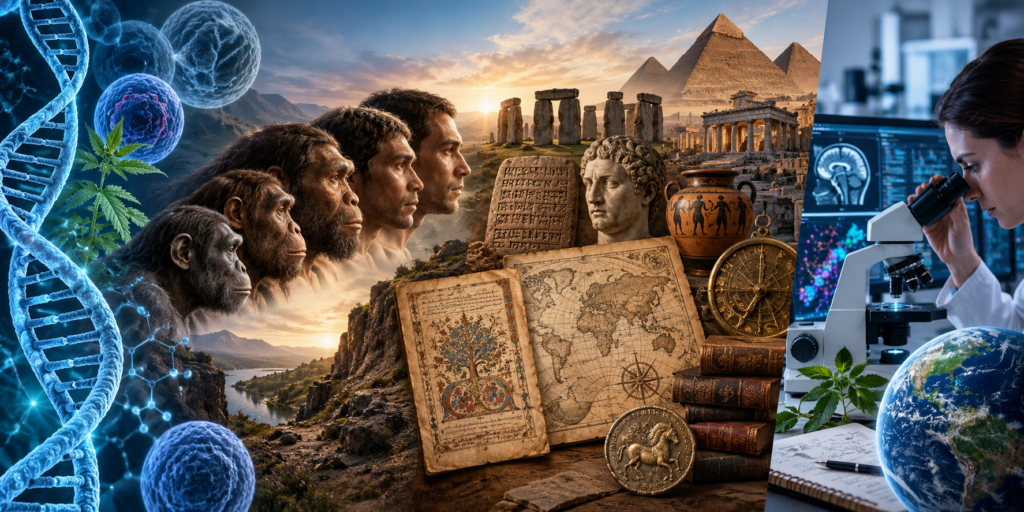
Ideas I explore
Biology, environment & who we become
Genes matter enormously, but DNA does not operate independently of development and experience. Epigenetics, nutrition, stress, learning, culture and environment all contribute to the biological individual who eventually emerges.
This relationship between inheritance and experience runs through much of my scientific work—and through my writing about aging, human evolution and identity.
Human evolution & alternative possibilities
Neanderthals and other extinct humans are usually discussed as inhabitants of a vanished past. But they also provide an extraordinary way of thinking about ourselves.
How different would another human species actually be if raised in our environment? Which differences would remain biological, and which might disappear through development, education and culture?
Questions like these turn evolutionary biology into something larger: an investigation of what we really mean by human.
Ancient knowledge through a scientific lens
Ancient societies developed complex systems of medicine, architecture, ritual, symbolism and relationships with the natural world.
Some ancient claims are clearly incompatible with modern evidence. Others may contain observations embedded in explanations that no longer make sense to us.
Rather than beginning with belief or dismissal, I am interested in asking: what part of the claim is testable?
History, evidence & lost worlds
The past reaches us unevenly. Stone survives better than wood. Monumental buildings survive better than ordinary homes. Written records preserve the priorities of particular institutions and societies, while landscapes themselves can disappear beneath water, sediment or later cities.
Maps, archaeology, genetics, geology and historical documents therefore provide different—and sometimes conflicting—windows onto the past.
I am particularly interested in the boundary between established history, unresolved evidence and speculation, and in making those distinctions explicit rather than pretending they do not exist.
Health, aging & the biology of everyday life
Some of the most consequential scientific questions are also intensely personal: Why do we age differently? How much can nutrition alter long-term health? What role do inflammation, metabolism and the endocannabinoid system play? Which interventions genuinely improve health rather than simply generating persuasive claims?
These subjects require the same combination of openness and skepticism as questions about the distant past.
Curiosity without requiring belief
I do not think intellectual curiosity requires accepting every unconventional idea. Nor does scientific skepticism require dismissing a question before examining the evidence.
Between those extremes is a much more interesting territory: asking difficult questions, separating evidence from interpretation, and being willing to discover that the answer is different from the one we expected.
That is the territory I hope to explore here.