Teaching science as a way of thinking
Teaching, for me, is not simply the transfer of information. Scientific knowledge changes constantly, and students will eventually work with technologies, questions and discoveries that may not exist when they enter university.
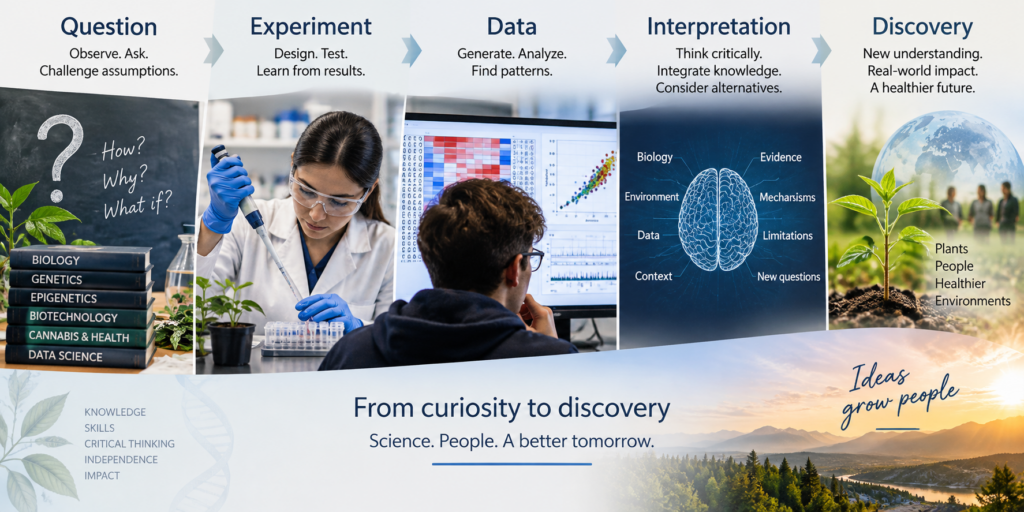
My goal is therefore to help students understand how to think scientifically: how to evaluate evidence, distinguish observation from interpretation, question assumptions, design meaningful experiments and change a conclusion when the evidence requires it.
I also try to connect fundamental concepts with problems students can recognize beyond the classroom—from heredity and environmental stress to biotechnology, medicine, cannabis and human health.
Areas I teach
Genetics & molecular biology
How information is stored, transmitted and altered in biological systems, from DNA and genome organization to mutation, recombination and gene regulation.
Epigenetics & environmental biology
How gene activity is regulated beyond DNA sequence, how organisms respond to environmental conditions, and how some biological responses may persist through cellular or even generational memory.
Biotechnology & bioinformatics
How molecular biology can be translated into experimental tools and practical applications, increasingly incorporating genomics, computational analysis and large biological datasets.
Cannabis & Human Health
An evidence-based examination of cannabis and cannabinoids—from the biology of the plant and the endocannabinoid system to pharmacology, therapeutic applications, adverse effects and the scientific evidence surrounding medical use.
Mentorship & research training
A large part of scientific education happens outside the formal classroom. I have trained and mentored undergraduate students, graduate students, postdoctoral researchers and other trainees working across molecular biology, plant science, epigenetics, biotechnology and human-health research.
I encourage students to develop independence rather than simply execute instructions. That means learning how to formulate a question, recognize when an experiment or analysis has failed, troubleshoot it, interpret unexpected results and decide what should be done next.
Increasingly, this training also combines traditional experimental biology with bioinformatics, computational biology and machine learning, allowing students to work across the boundary between laboratory experiments and large biological datasets.
Opportunities for graduate students
Graduate student opportunities are available periodically, depending on current projects and funding. Research in my laboratory spans interdisciplinary projects connecting molecular biology with modern computational approaches.
Current areas include plant epigenetics and environmental stress, small-RNA and DNA-methylation biology, cannabis and medicinal-plant research, cannabinoids and human health, biomarkers, transcriptomics, bioinformatics and machine learning.
Students can develop projects emphasizing experimental biology, computational analysis, or a combination of both, depending on their background and interests.
The larger goal
The most valuable outcome of scientific training is not memorizing what is already known. It is developing the ability to confront something that is not yet known and work out how to investigate it.
That is the ability I most want students to take with them.