From discovery to application
Much of my research begins with fundamental biological questions, but I have always been interested in what happens when those discoveries move beyond the laboratory. Innovation, to me, is not simply commercialization. It is the process of turning biological understanding into new technologies, therapeutic strategies, analytical tools and practical solutions.
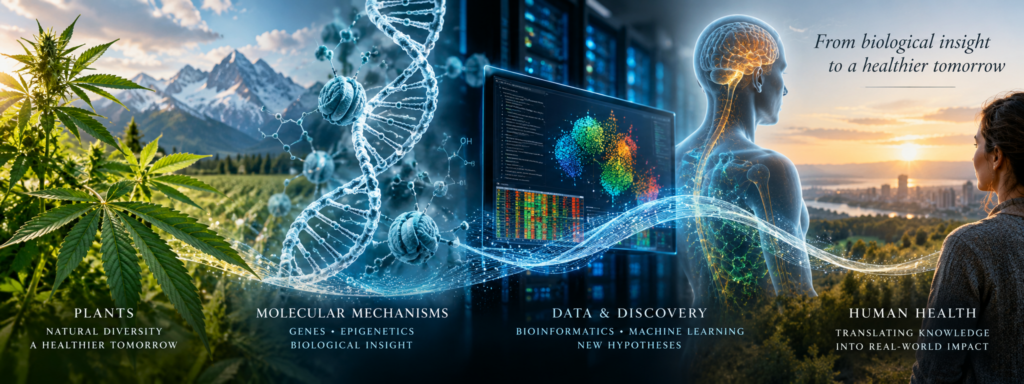
My work has crossed several areas where this translation is particularly important: plant biotechnology, medicinal plants and cannabis, cannabinoid-based approaches to human health, molecular biomarkers, and computational methods for understanding complex biological systems.
Biotechnology & plant innovation
Research in plant genetics, epigenetics and environmental responses can provide tools for developing crops that are more resilient, productive or biologically valuable. My work has explored genome stability, stress adaptation, gene regulation and biotechnology, including approaches relevant to medicinal and economically important plants.
Cannabis, cannabinoids & therapeutics
Cannabis provides an unusual bridge between plant biotechnology and medicine. My work spans both sides of that bridge—from the biology and improvement of the plant itself to understanding how cannabinoids interact with human physiology.
A major goal is to move cannabinoid research toward evidence-based therapeutics: identifying compounds, doses, biological targets and patient responses rather than treating cannabis as a single medicine.
Biomarkers & precision health
People can respond very differently to the same disease or treatment. Molecular biomarkers may help explain that variation.
My research increasingly combines transcriptomics, epigenetics and other molecular data with clinical outcomes to identify biological signatures associated with disease, treatment response and healthy aging. The longer-term goal is to help move interventions from population averages toward more individualized approaches.
Computational biology & machine learning
Modern biological research produces datasets that are too large and interconnected to understand one variable at a time. Bioinformatics, molecular modelling and machine learning provide ways to discover patterns across genomes, epigenomes, gene expression and molecular interactions.
I use these approaches both to revisit existing biological questions and to generate new hypotheses that can subsequently be tested experimentally.
Connecting disciplines
The most interesting innovations often emerge between established fields. Plant biology can inform medicine. Molecular biology can intersect with computation. Natural products can lead to therapeutic hypotheses. Fundamental discoveries can become technologies in ways that were not obvious when the original experiment was designed.
That movement—from understanding a biological system to asking what we can responsibly do with that understanding—is the thread connecting my work in innovation.